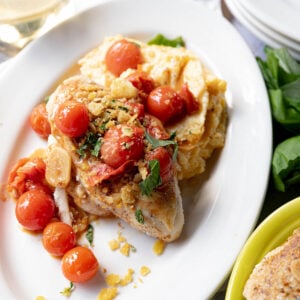
Crispy Skin-On Chicken Breasts with Blistered Tomatoes
This crispy skin-on chicken with blistered cherry tomatoes features boneless skin-on chicken breasts seared until shatteringly crisp, a glossy lemon butter sauce with blistered cherry tomatoes built on the fond, served over creamy Parmesan polenta and finished with pangrattato (crispy golden toasted breadcrumbs). Ready in 50 minutes and exactly the dinner party dish that doesn't require spending all day in the kitchen.
Equipment
- Large stainless or cast iron skillet
- Medium saucepan (for polenta)
- Wire rack
- Wooden spoon or whisk
- tongs
- Spoon (for basting)
- Paper towels
- instant read thermometer
- cutting board
- Sharp knife
Ingredients
For the Chicken
- 4 boneless skin-on chicken breasts (6 to 8 ounces each)
- Kosher salt about 1 1/2 teaspoons
- Freshly ground black pepper about 1 teaspoon
- 2 tablespoons olive oil
- 4 tablespoons unsalted butter
For the Sauce
- 4 garlic cloves thinly sliced
- Zest of 1 lemon
- ½ cup dry white wine
- 1 pint cherry tomatoes
- 3 tablespoons unsalted butter cold and cubed
- 1 tablespoon fresh lemon juice
- ¼ cup fresh basil leaves torn
- Flaky salt for finishing
For the Pangrattato
- ½ cup panko or fresh coarse breadcrumbs
- 2 tablespoons olive oil
- ½ teaspoon lemon zest
- 1 tablespoon chopped fresh parsley
- Pinch of kosher salt
For the Parmesan Polenta
- 2 cups whole milk
- 2 cups water
- 1 cup polenta not instant
- 4 tablespoons unsalted butter
- ¾ cup freshly grated Parmesan
- Kosher salt and freshly ground black pepper to taste
Instructions
- Start the polenta. Combine the milk and water in a medium saucepan and bring to a gentle boil. Whisk in the polenta in a slow, steady stream, then reduce heat to low. Cook, whisking every few minutes, for 30 minutes, until thick and very creamy. Season generously with salt and pepper as it cooks — don’t wait until the end.2 cups whole milk, 2 cups water, 1 cup polenta, Kosher salt and freshly ground black pepper
- Time to make the pangrattato. While the polenta cooks, heat the olive oil in a small skillet over medium heat. Add the breadcrumbs and a pinch of salt and toast, stirring constantly, for 3 to 4 minutes, until deeply golden. Off heat, stir in the lemon zest and parsley. Set aside uncovered — covering traps steam and softens the crunch. Note: make this in the same pan you’ll use to sear the chicken and build the sauce — fewer dishes.½ cup panko or fresh coarse breadcrumbs, 2 tablespoons olive oil, ½ teaspoon lemon zest, Pinch of kosher salt, 1 tablespoon chopped fresh parsley
- Pat the chicken breasts completely dry, skin and all. Season both sides generously with salt and pepper.4 boneless, Kosher salt, Freshly ground black pepper
- Heat the olive oil in a large stainless or cast iron skillet over medium-high heat until shimmering — not smoking. Lay the chicken skin-side down and do not touch it for 8 minutes. After about 4 minutes, press down gently with the back of a spatula or a pot lid to keep the skin in full contact with the pan. At 8 minutes, the skin should be deeply golden and crisp.2 tablespoons olive oil
- Flip the chicken and immediately add the butter to the pan. As it melts and foams, baste the flesh side continuously, tilting the pan to pool the butter and spooning it back over the chicken again and again. Cook for about 6 minutes, basting the whole time, until the chicken reaches 160 degrees Fahrenheit (71°C) internally.4 tablespoons unsalted butter
- Transfer the chicken to a rack, skin-side up, while you build the sauce. If you don’t have a rack, a large plate works — just keep the chicken in a single layer.
- Now it’s time to work on the sauce. Pour off all but about 2 tablespoons of fat from the pan. Add the sliced garlic and lemon zest and cook over medium-low heat for 30 to 45 seconds, just until fragrant — pull it before the garlic colors, or it turns bitter.4 garlic cloves, Zest of 1 lemon
- Pour in the white wine and scrape up every browned bit from the bottom of the pan. Let it bubble and reduce by about half, 60 to 90 seconds, before adding anything else. This is what separates a sauce that tastes built from one that just tastes like wine was added.½ cup dry white wine
- Next, add the cherry tomatoes, cover, and cook for 3 to 4 minutes to steam them until they’re about to burst. Uncover and continue cooking for another 3 to 4 minutes, letting some of the tomatoes collapse fully into the wine while others stay just intact.1 pint cherry tomatoes
- Remove the pan from the heat. Add the cold butter a couple of cubes at a time, swirling the pan to melt each addition into the sauce before adding more. This is what gives you a glossy, emulsified sauce instead of a greasy one. Stir in the lemon juice, then fold in the torn basil.3 tablespoons unsalted butter, 1 tablespoon fresh lemon juice, ¼ cup fresh basil leaves
- Now, finish the polenta. Off heat, stir the butter and Parmesan into the polenta until melted and smooth. Taste and adjust salt and pepper — it should taste fully seasoned on its own, not rely on the sauce to carry it.4 tablespoons unsalted butter, ¾ cup freshly grated Parmesan
- Spoon polenta onto plates or a platter and set the chicken on top, skin-side up so it stays crisp. Spoon the tomatoes and sauce around the chicken. Finish with the pangrattato and flaky salt, if you’d like.Flaky salt
Notes
- Don't touch the chicken for the full 8 minutes on the skin side. Every peek or move before then is lost crust. The skin releases naturally when it's ready; that's your signal to flip!
- Shimmering, not smoking. Smoking oil will scorch the skin before the inside cooks through. You want the oil glistening and just barely moving in the pan.
- Baste continuously once you flip. This is what keeps the flesh side from drying out while the skin side stays crisp off direct heat. Don't put the spoon down!
- Scatter the pangrattato at the very last second. It's the only element in this dish meant to stay crunchy so it can't sit under the sauce or steam for even a minute.
- Cold butter off heat is non-negotiable for the sauce. Add it a few cubes at a time and swirl the pan to melt each addition; this is what gives you a glossy emulsified sauce rather than a broken oily one.
- Storage: The chicken and sauce keep refrigerated for up to 3 days; reheat gently in a covered skillet over low heat so the sauce doesn't break. The polenta will firm up in the fridge; loosen it with a splash of milk as it reheats. The pangrattato doesn't hold so make it fresh or skip it on leftovers.
Nutrition Facts
Calories: 928kcalCarbohydrates: 55gProtein: 42gFat: 58gSaturated Fat: 28gPolyunsaturated Fat: 4gMonounsaturated Fat: 22gTrans Fat: 1gCholesterol: 182mgSodium: 603mgPotassium: 1009mgFiber: 2gSugar: 11gVitamin A: 2083IUVitamin C: 31mgCalcium: 440mgIron: 3mg
Tried this recipe?Let us know how it was!